
Improving food safety requires practical solutions that reach the people who handle, store and sell food every day. In Moniya, Nigeria, the FoodSafety4Africa (FS4Africa) team at the International Institute of Tropical Agriculture (IITA) recently brought this approach directly to grain vendors through a market-based food safety awareness outreach.
The activity followed a meeting held on 2 September 2026 between the IITA Food Safety Team and the Chief of Moniya Farmers’ Market, during which the team received approval to conduct an outreach within the market.
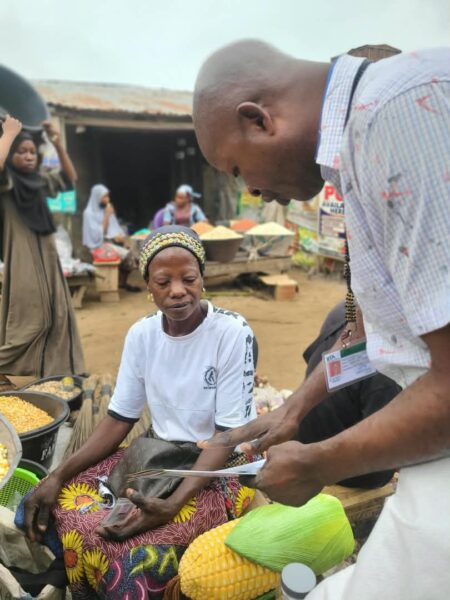
During the visit, the team engaged more than 33 grain vendors, raising awareness about the health risks linked to improper pesticide use and the potential presence of pesticide residues in food. The discussions highlighted the importance of safer pest management practices, particularly during post-harvest handling and storage.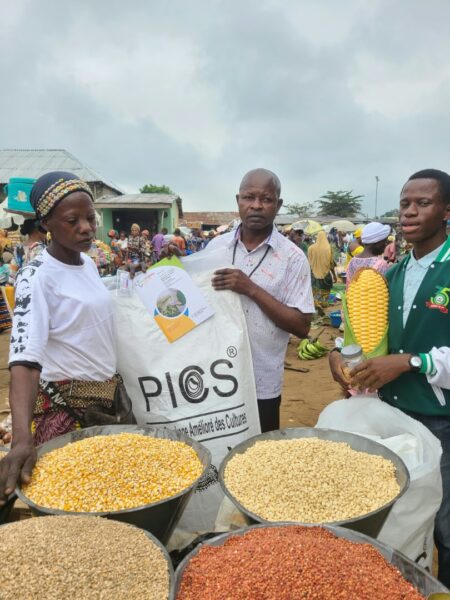
The outreach also introduced vendors to practical grain storage solutions, including Dry Cards and Purdue Improved Crop Storage (PICS) Bags. The team demonstrated how these tools can be used correctly to support safer storage conditions and help protect grains from pests, moisture and mould development.
Proper storage is particularly important in reducing conditions that can contribute to contamination by harmful toxins such as aflatoxins. By combining awareness on pesticide use with demonstrations of improved storage practices, the activity addressed multiple food safety risks that can affect grain value chains.
This work closely reflects the wider objectives of FS4Africa. The project aims to improve African food safety systems, with particular attention to the informal sector, by supporting practical approaches that strengthen local markets, food security and public health. Pesticide residues and mycotoxin contamination are among the key food safety challenges addressed by the project.
The outreach also aligns with FS4Africa’s Use Cases on sustainable aflatoxin management and reducing toxic pesticid e residues. The project specifically promotes improved post-harvest management practices, capacity building for food-system actors and the adoption of hermetic storage solutions such as PICS Bags, particularly within informal-sector settings.
By engaging vendors directly in their working environment, the Moniya outreach demonstrates how food safety knowledge can be translated into practical action. Strengthening the capacity of local value-chain actors is an important step towards safer food, healthier communities and more resilient food systems across Africa.
 SW
SW  EN
EN  FR
FR  DE
DE  NL
NL  SL
SL  EL
EL  AF
AF  AR
AR  AM
AM  ZU
ZU